
One of the most common requests European parts manufacturers bring to africon is a clean map of how their product reaches end users in a target African country, and which partner will get it there. Those are really two halves of one question. First, which channels actually carry replacement parts to the people who fit them. Second, given those channels, who the right distribution partner is. Neither half has a tidy, continent-wide answer; both depend heavily on the country and partly on the product category.

Service parts and the informal share
A large share of service parts (the items replaced on a regular interval, such as engine oil, oil filters, sealing rings and spark plugs) flows through informal and semi-formal markets in much of the continent. This is where the cheap parts compete on price, and in many African countries it is the largest channel by volume, especially in Sub-Saharan markets. Volume on its own is not the same as quality demand, though: many of those volumes sit in price brackets a Western supplier cannot realistically meet.
Formal mechanics
South Africa looks closer to Europe than people often expect. A sizeable share of small garages and independent mechanics operate in a formal business context and routinely buy quality parts. Morocco shows a similar pattern. In other Sub-Saharan markets the formal mechanic share is meaningfully smaller, and more parts go through informal channels.
OEM workshops
The top of the market sits with authorised OEM workshops, for example the Volkswagen dealer workshop or the Toyota dealer workshop, which fit original parts. For the average automotive aftermarket producer this channel is to a large extent not directly accessible. It is worth knowing it exists; it is rarely worth building a route to market around it.
Fleets with in-house workshops
For commercial vehicles, the most reliable quality-buying channel is often the fleet itself. A logistics company running several hundred trucks tends to buy good-quality parts, because a breakdown costs them a customer relationship. If your product is for trucks or buses, fleets are an important channel to map directly.
Fast fitters
Formal fitment centres, the chains where customers drive in for wheel alignment, new tyres, shock absorbers or batteries, are a strong channel in South Africa and a thinner one elsewhere on the continent. If you sell batteries, tyres or shock absorbers in particular, the South African fitment channel deserves specific attention. In most other countries it exists at a much smaller scale and is rarely the route to optimise around.
Source: africon research 2020
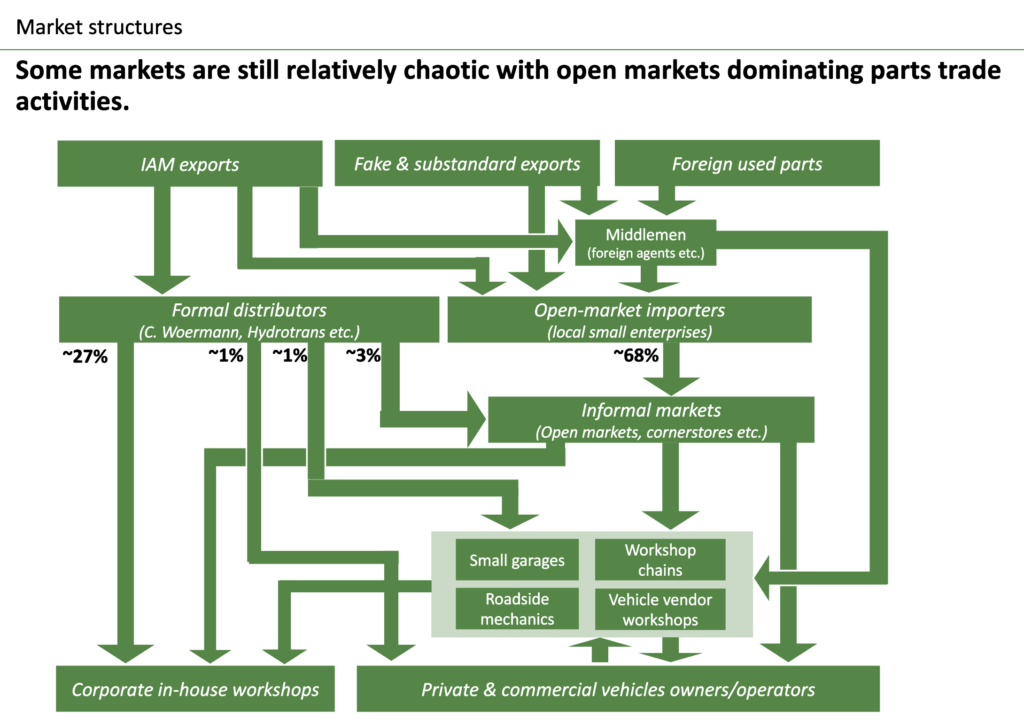
What this slide shows: the structure of an African automotive aftermarket, from open-market importers and formal distributors to informal markets, small garages, roadside mechanics, workshop chains, vehicle-vendor workshops and corporate in-house workshops, with approximate channel shares (around 68% / 3% / 27% / 1% / 1%).
The channel decides the partner
Once you know which channels carry the buyers who actually pay for quality, the partner question almost answers itself, and this is where most European suppliers go wrong. There is no single right distribution partner for all suppliers in all countries. The right partner depends on the same two variables as the channels: the product category and the country.
Match the partner to where the volumes sit
For batteries and shock absorbers in South Africa, a large share of the higher-quality volumes moves through the formal fitment centres described above, so the right partner is typically a distributor with strong access to those chains. A distributor whose strength is in service parts, such as spark plugs, filters and engine oil, sells through a different channel mix, mainly small mechanics and informal trade. The two distributor profiles can look similar from the outside, but they reach almost no overlapping customers. Picking the wrong one looks fine on paper and misses the volumes that matter.
The “one big importer” mistake
Suppliers often arrive expecting to find one big, well-connected importer who moves real volumes, is financially sound, and covers the whole country. In a few markets this matches reality. Ivory Coast, for example, has a fairly structured market with a couple of relatively large names given its size, and working with one of them is workable. In other markets it does not match reality at all. Nigeria is the clearest example. There is no single large, well-connected distributor of the kind suppliers picture. The wholesale layer is fragmented, importers are reluctant to buy from each other inside the country, and any container that arrives is often a co-load between several smaller players. Hunting for the one big partner in Nigeria ends one of two ways: you do not find it, or you find someone well connected in one slice of the market who cannot reach the many smaller buyers who together hold the bulk of demand.
Cities, not countries
Even within a single country the picture can fragment by geography. Kenya splits between Nairobi-based importers and Mombasa-based importers, and the two overlap less than a European market map would suggest. The partner question is therefore sometimes a partner-plural question, with a separate set-up for each commercial hub.
When the local market does not support a single answer
For markets like Nigeria, a foreign trading company based outside the country, often in Dubai, is sometimes the right structural answer. It lets the supplier reach the long tail of small importers who bring in a couple of containers a year, often grouped with a few peers, without trying to do that distribution job directly. This is a deliberate structural choice, not a fallback. In some countries it is the only practical way to address the volumes that exist.
What to map before choosing
Before settling on a partner, the questions worth answering for the priority country are: is the market centralised or fragmented; is the buyer base broadly quality-aware or price-led; which segments actually buy quality; and how do volumes split across the channels above. The right partner, and sometimes the right several partners, falls out of those answers.
The channel mix and the partner that fit your product in your priority country are exactly what africon is set up to work through with you.